Kucoin margin trading can fund leveraged orders through Auto-Borrow
Last updated
Kucoin margin trading can use Auto-Borrow to obtain the assets required for leveraged buy or sell orders. Manual Borrow provides a separate path for choosing the asset and loan amount before trading. Both methods require a supported margin market, eligible collateral and available lending supply. Borrowing creates interest costs and a repayment obligation. Cross and isolated margin determine which account assets support that debt and which balances face liquidation risk.
A successful Auto-Borrow loan begins accruing interest even if the associated trading order remains unfilled.
From a supported margin pair to a funded order
Consider a margin order requiring more funding than the selected account has available. Before borrowing, the account must have completed identity verification and hold the necessary margin permissions. Its pair and borrowing currency must match the chosen margin mode before submission. These conditions determine whether automatic funding or a manually arranged loan can support the intended order:
- The pair supports the selected cross or isolated margin mode.
- The required borrowing asset is eligible in that mode.
- Collateral and the displayed borrowing limit cover the requested loan.
- Auto-Borrow is selected, or sufficient funds are already available through Manual Borrow.
- The lending market can supply the required currency when the loan is requested.
Available funding and a filled order
With those conditions satisfied, Auto-Borrow requests the funding required when the order is placed. Manual Borrow uses funds obtained beforehand. Once the trade fills, its execution record identifies the assets exchanged, and the selected margin account reflects the received asset. Borrowing records separately establish the loan amount. An accepted order alone does not establish that a trade filled.
Collateral in another isolated pair
An isolated order cannot use collateral held in another pair's margin account. The selected pair's account needs its own supported collateral before borrowing can succeed. Switching to Manual Borrow does not change that boundary. A transfer must satisfy the originating account's transfer limits and the receiving pair's supported-asset rules.
When does Manual Borrow provide more control?
Manual Borrow gives control over the loan asset and amount before an order reaches the market.
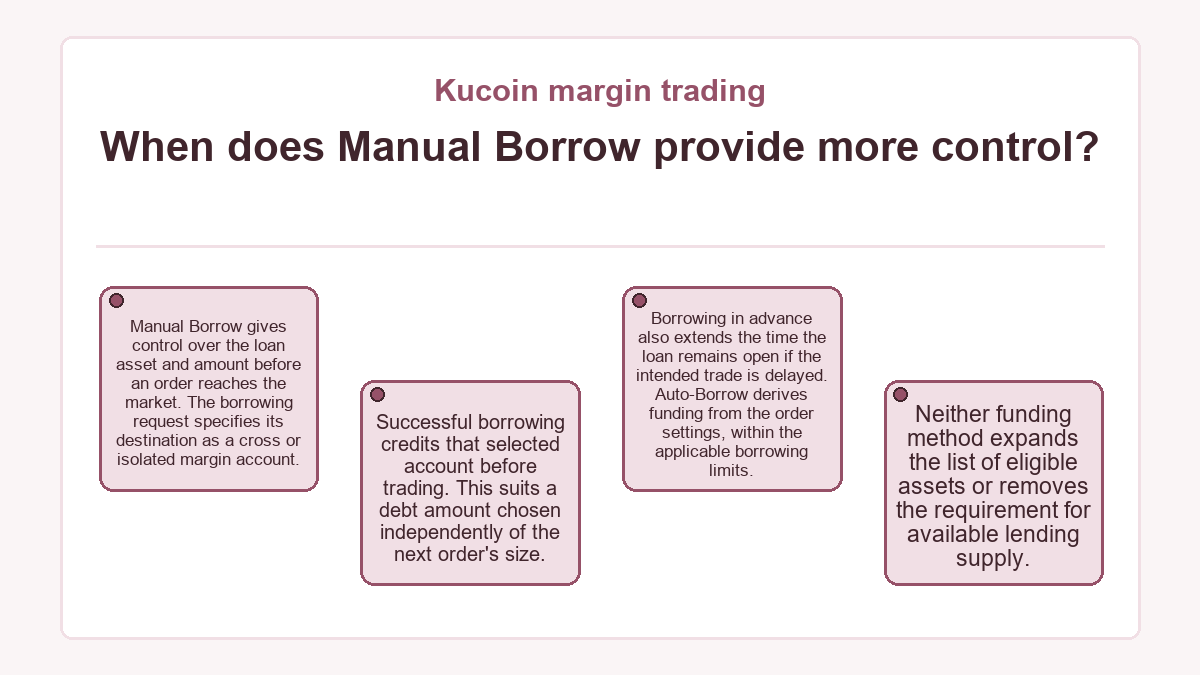
The borrowing request specifies its destination as a cross or isolated margin account. Successful borrowing credits that selected account before trading. This suits a debt amount chosen independently of the next order's size. Borrowing in advance also extends the time the loan remains open if the intended trade is delayed. Auto-Borrow derives funding from the order settings, within the applicable borrowing limits. Neither funding method expands the list of eligible assets or removes the requirement for available lending supply.
Cross and isolated margin expose different collateral
Cross margin
Cross margin pools supported assets in one margin account with a shared debt ratio. Gains or collateral within that account can support its combined obligations. The shared pool also exposes assets unrelated to one particular trade when accountwide debt becomes too large. This collateral exposure belongs to the cross margin account; it should not be confused with the balance of every account held on the exchange.
The classic margin rules updated in March 2026 list a 5x cross-margin ceiling. Asset-specific risk limits and collateral valuation can reduce actual borrowing capacity.
Isolated margin
Each isolated trading pair has its own margin account and debt ratio. Only the pair's two assets can be transferred into, held in or borrowed from that account. Funds allocated to another pair do not form part of its collateral pool.
Isolated leverage can reach 10x under those classic rules, although the maximum varies by pair. Allocating less collateral restricts the assets exposed within that account. For the same outstanding debt, less collateral leaves less capacity to absorb adverse price movements; isolation does not prevent liquidation.
What does a margin loan add to trading costs?
A margin loan adds interest to the trading fees and execution costs of the underlying orders.
Borrowing time and variable rates
Interest begins accruing as soon as a margin loan succeeds. Kucoin applies later interest calculations hourly, using the principal and applicable hourly rate. Market supply and demand can change that rate, so one displayed rate does not fix the total cost of an open loan. Interest records show the charges applied to the specific borrowed currency.
An unfilled order can therefore carry borrowing costs when its Auto-Borrow loan has already succeeded.
Trading fees and execution prices
Trading fees depend on the selected pair, fee level and whether execution adds or removes order-book liquidity. Increasing traded volume can increase the associated fees. Entry and exit involve separate executions, each with its own trading costs. Spread and slippage also affect the price obtained, independently of loan interest. The spread separates buy and sell quotes; slippage describes a difference between the expected and executed price. A favorable price move may still leave an unfavorable net outcome after financing and execution costs.
Repayment follows the borrowed asset
With Auto-Repay selected, proceeds from a fully executed order go toward existing liabilities in the currency received. The repayment amount depends on those proceeds and the debt to discharge. Long positions funded by borrowed quote currency need that currency back. Short positions funded by a borrowed base asset need units of that asset for repayment. Closing direction matters because selling and buying return different currencies.
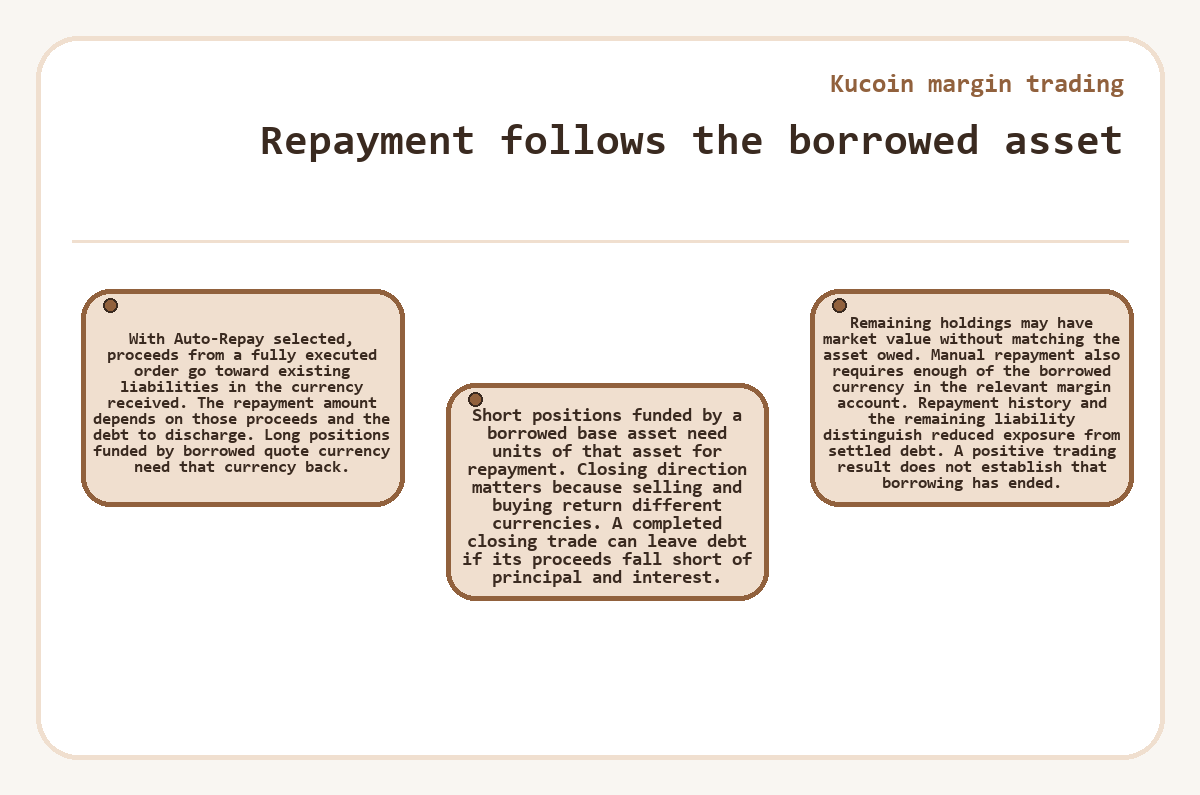
A completed closing trade can leave debt if its proceeds fall short of principal and interest. Remaining holdings may have market value without matching the asset owed. Manual repayment also requires enough of the borrowed currency in the relevant margin account. Repayment history and the remaining liability distinguish reduced exposure from settled debt. A positive trading result does not establish that borrowing has ended.
Debt ratio can rise while orders remain idle
The debt ratio compares a margin account's liabilities with the value of its assets. Liabilities include borrowed principal and interest, while asset values follow the applicable valuation rules. Falling collateral value or a rising price of a borrowed asset can worsen the ratio. An outstanding loan therefore carries account risk even when no new trade occurs.
The classic margin rules updated on March 3, 2026 specify an alert at a 92% debt ratio and forced liquidation at 95%. Notification delivery follows account security settings, and rapid price changes can reach liquidation before you react.
During forced liquidation, the system cancels outstanding orders and blocks additional orders and incoming transfers into the affected margin account. Repaying debt or adding collateral can reduce risk before that boundary. Funds held in another account do not provide additional margin collateral until they reach the relevant margin account. The system sells assets from the affected margin account to repay debt, then deducts a handling fee from any residual balance. The fee rate varies by the assets and liabilities involved.
Margin borrowing and unleveraged spot serve different tasks
Margin borrowing adds funded buying power or a borrowed asset for a short sale. Leverage can magnify gains and losses relative to your own capital. Unleveraged spot trading uses existing funds without creating a margin loan. Choosing spot removes the margin-interest obligation for that trade, while ordinary trading costs and price exposure remain. Futures use a different contract and collateral model; their funding payments and risk metrics should not be substituted for margin-loan terms.
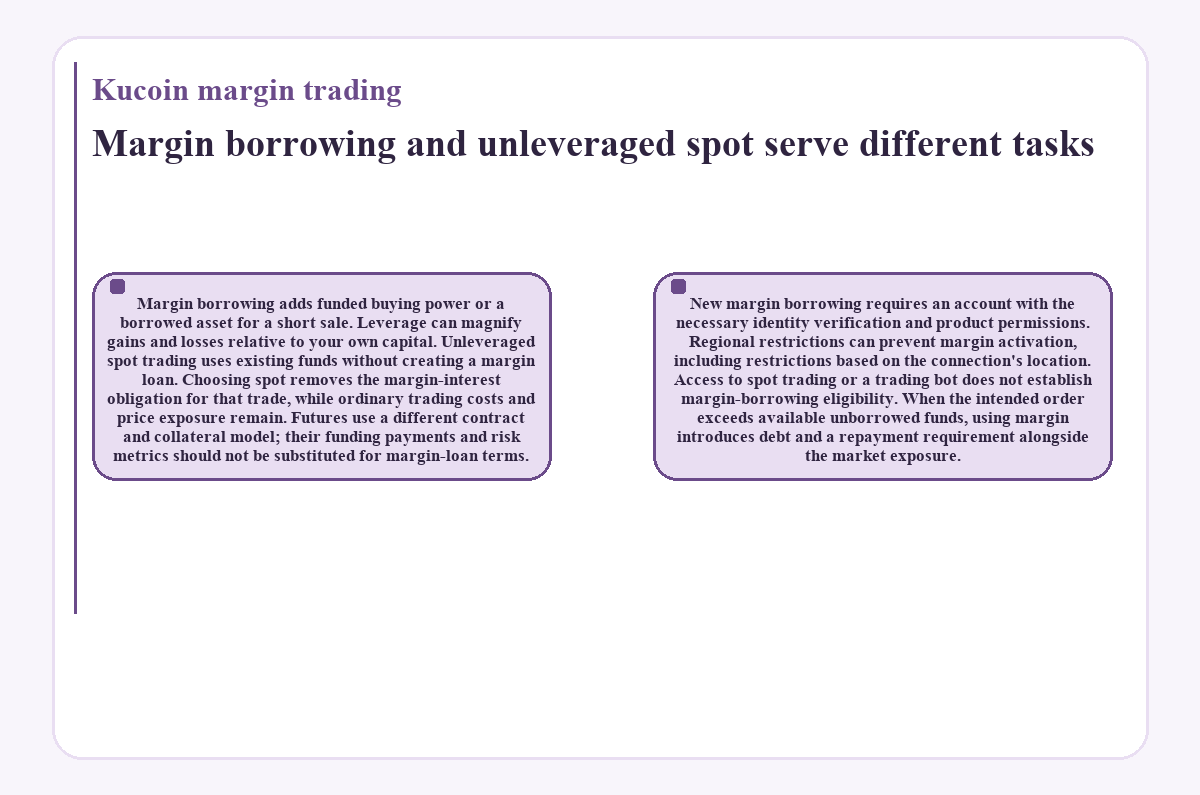
New margin borrowing requires an account with the necessary identity verification and product permissions. Regional restrictions can prevent margin activation, including restrictions based on the connection's location. Access to spot trading or a trading bot does not establish margin-borrowing eligibility. When the intended order exceeds available unborrowed funds, using margin introduces debt and a repayment requirement alongside the market exposure.
Questions and answers about Kucoin margin trading
Does Auto-Borrow remain enabled for later margin orders?
Auto-Borrow remains active in the trading interface until you disable it. It can initiate borrowing during a later trade, including an order intended to close exposure. The resulting loan depends on the funding required and the applicable borrowing conditions. A previous trade does not reset the setting, so confirm the selected order mode before submitting another margin order.
Why is my maximum borrowable amount below the leverage ceiling?
The leverage ceiling does not give every margin asset equal borrowing value. Kucoin applies tiered collateral ratios when calculating maximum borrowing and transfer amounts. Different tiers recognize different proportions of an asset's notional value, and these ratios can change with market conditions. Asset-specific borrowing caps also apply; for some currencies, these caps vary by VIP level. The displayed borrowing maximum reflects those constraints. Tiered collateral ratios do not change the debt-ratio or forced-liquidation calculations.
Can an older unverified account use Auto-Borrow to close a margin position?
An older unverified account cannot use Auto-Borrow when its account permissions disable new borrowing. Accounts registered before August 31, 2023 (UTC) that remain unverified have restricted margin permissions: repayments and certain closing trades remain available while borrowing is disabled. Permitted buy orders purchase assets already owed; they do not establish new positions in other currencies. Closing permission therefore does not authorize another loan to fund that order.
Are margin profits immediately available to transfer out?
Margin profits are transferable only within the account's applicable outward-transfer limits. Outstanding debt and collateral requirements can leave part of the holdings unavailable, even after a profitable trade. The displayed maximum transferable amount establishes how much can leave the selected margin account. Moving all remaining funds out requires settling the borrowed principal and interest first. Available transfer capacity does not itself establish that all loans have been repaid.
How can hourly interest affect margin assets without another trade?
Hourly interest can increase margin debt or reduce holdings without a new trading order. Kucoin normally borrows the interest amount from the lending pool, pays the lender and adds that amount to the borrower's debt. Interest borrowing can fail if the currency is delisted from lending or both trading and lending markets lack depth. The system then deducts interest from sufficient holdings of that currency, or sells assets to cover it.