Kucoin combines order-book trading with derivatives and account services
Last updated
Kucoin is a centralized crypto exchange with spot order books, futures contracts and tools for managing exchange-held balances. Buyers and sellers trade assets through matching orders, while derivatives provide price exposure supported by collateral. Costs vary with execution type, market and account tier. Identity verification and regional rules also determine which services an account can access.
Spot trading, quoted conversions and peer-to-peer purchases use different pricing methods. Margin trading adds borrowing obligations, while trading bots automate orders. Earn products offer subscriptions with product-specific returns and redemption terms. Those differences affect the final cost and when assets remain available.
Account balances support spot orders and quoted conversions
The classic account layout separates balances by function, with a Trading Account supplying spot orders and a Funding Account supporting deposits, withdrawals and P2P trading. Crypto deposits can go directly into the Trading Account where that option is available. An internal transfer moves an existing asset balance between accounts without exchanging it for another asset. Margin and futures accounts hold funds for their respective trading activities. A total portfolio balance therefore does not necessarily show the amount available for a particular order.
The Unified Trading Account (UTA) supports shared collateral across spot, margin and futures trading. UTA is primarily available to VIP 2 and above; users below that tier can request access through an account manager. Its collateral eligibility and risk controls differ from the classic layout.
Convert provides another exchange method, with Market and Limit modes. Market conversion presents a quote for acceptance; Limit conversion sets a requested exchange rate. A displayed market price reaching that rate does not assure execution, because depth and liquidity also matter. Quote expiry can change the amount shown for a Market conversion.
What determines the full cost of a trade?
Trading cost combines the execution fee with spread and possible slippage, while the fee schedule varies by market and account tier. The spread separates the best buying and selling quotes. Slippage describes a difference between an expected price and the price actually obtained.
Maker orders add liquidity by resting in the order book. Taker fills consume that available liquidity. A limit order can execute immediately and incur taker fees, so its name alone does not determine the fee. Post-only restricts an order to maker execution. The applicable maker and taker rates appear in the market's fee information and account fee tier.
Pay Fees with KCS applies a 20% discount to eligible spot and margin fees. It requires activation and enough of the exchange's native token, KCS. Low fee rates can be ineligible, and conversion into KCS can reduce the effective discount. Fee history identifies the charged asset and rebate, which helps reconcile gross trading quantities with net account balances.
Convert charges no handling fee, but its quoted conversion rate may include a spread. That spread still affects how much the exchange returns.
Limit orders control price and allow partial fills
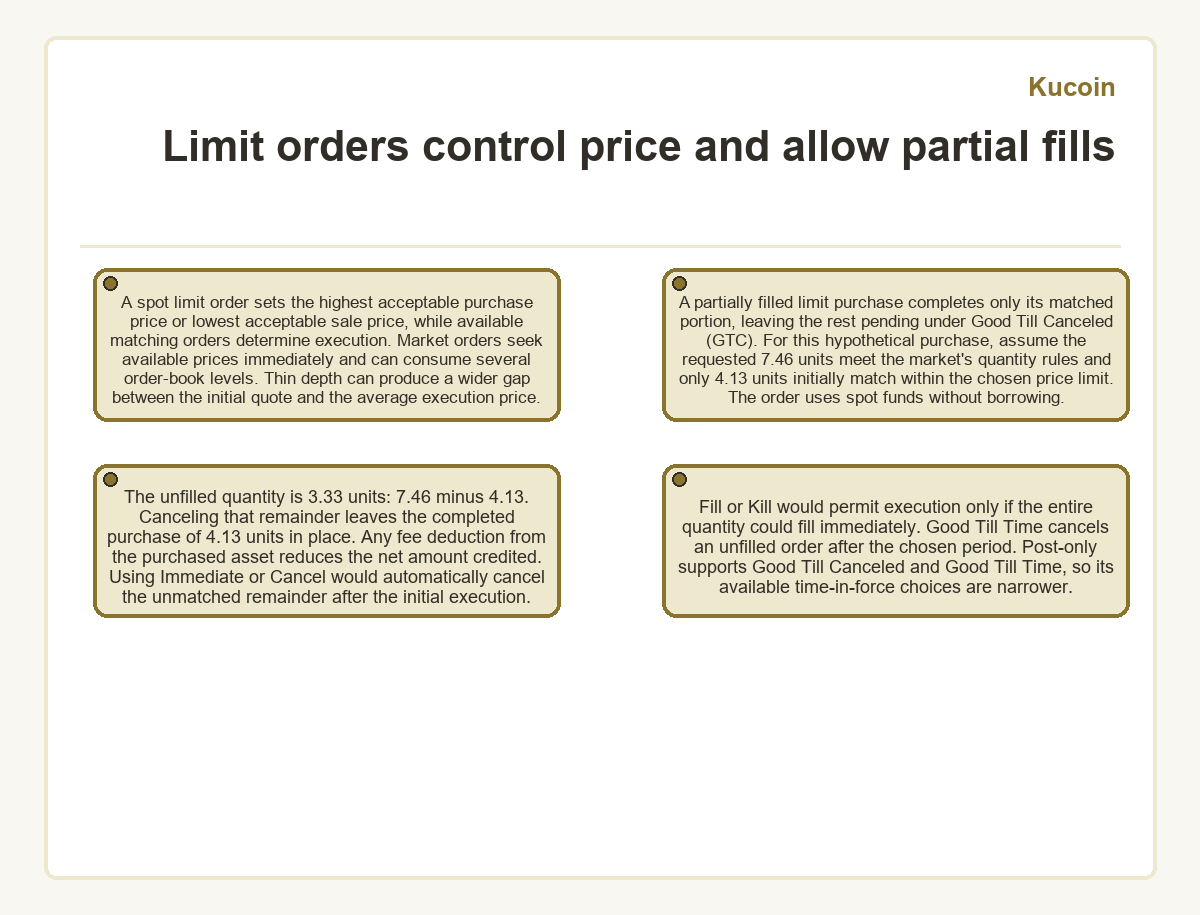
A spot limit order sets the highest acceptable purchase price or lowest acceptable sale price, while available matching orders determine execution. Market orders seek available prices immediately and can consume several order-book levels. Thin depth can produce a wider gap between the initial quote and the average execution price.
A partially filled limit purchase completes only its matched portion, leaving the rest pending under Good Till Canceled (GTC). For this hypothetical purchase, assume the requested 7.46 units meet the market's quantity rules and only 4.13 units initially match within the chosen price limit. The order uses spot funds without borrowing.
The unfilled quantity is 3.33 units: 7.46 minus 4.13. Canceling that remainder leaves the completed purchase of 4.13 units in place. Any fee deduction from the purchased asset reduces the net amount credited.
Using Immediate or Cancel would automatically cancel the unmatched remainder after the initial execution. Fill or Kill would permit execution only if the entire quantity could fill immediately.
Good Till Time cancels an unfilled order after the chosen period. Post-only supports Good Till Canceled and Good Till Time, so its available time-in-force choices are narrower.
Futures exposure uses collateral and funding
Futures trading creates exposure through contracts supported by margin, with leverage increasing the position size relative to the collateral supporting it. A long position benefits from an upward price move; a short benefits from a downward move. Adverse moves reduce the margin available to absorb losses.
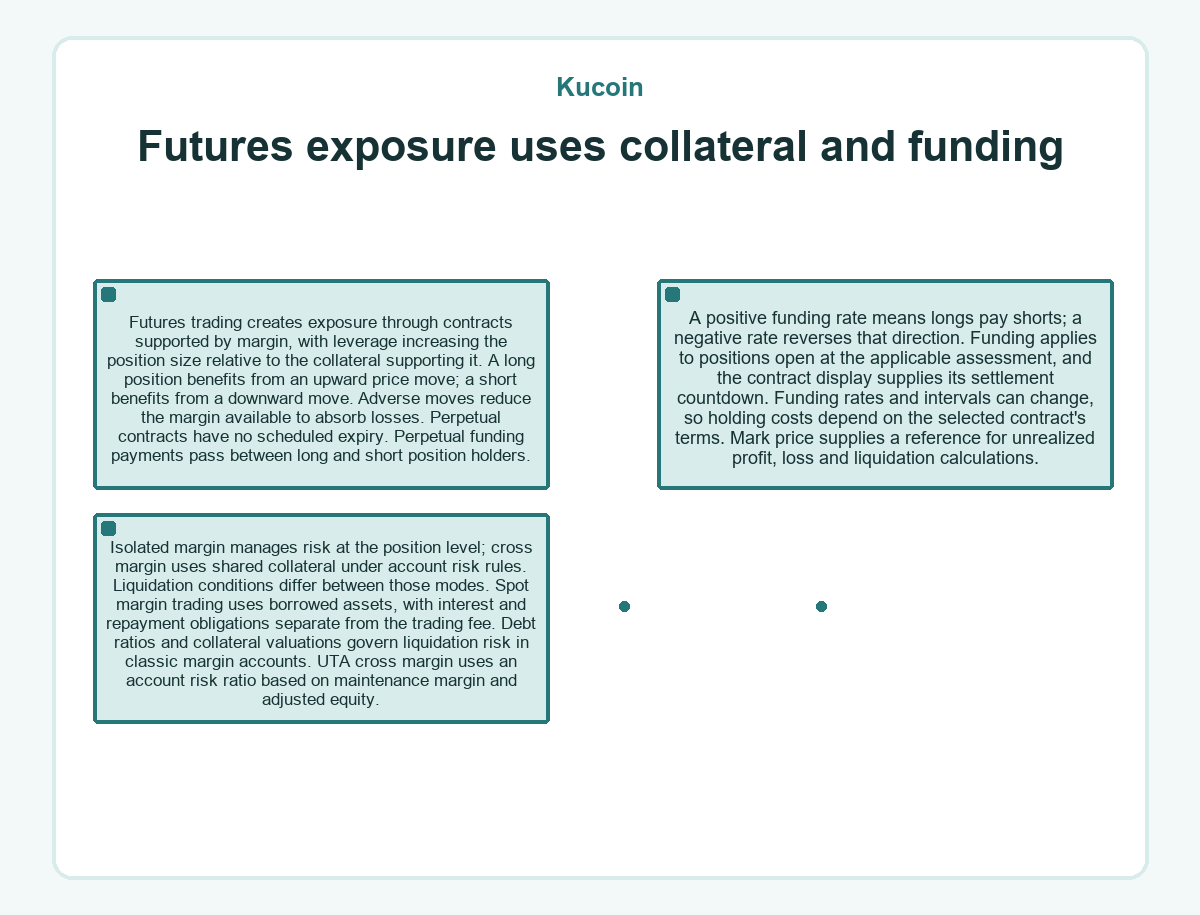
Perpetual contracts have no scheduled expiry. Perpetual funding payments pass between long and short position holders. A positive funding rate means longs pay shorts; a negative rate reverses that direction. Funding applies to positions open at the applicable assessment, and the contract display supplies its settlement countdown. Funding rates and intervals can change, so holding costs depend on the selected contract's terms.
Mark price supplies a reference for unrealized profit, loss and liquidation calculations. Isolated margin manages risk at the position level; cross margin uses shared collateral under account risk rules. Liquidation conditions differ between those modes. Spot margin trading uses borrowed assets, with interest and repayment obligations separate from the trading fee. Debt ratios and collateral valuations govern liquidation risk in classic margin accounts. UTA cross margin uses an account risk ratio based on maintenance margin and adjusted equity.
Automation and Earn put balances to different uses
Trading bots automate supported strategies, with Spot Grid organizing orders around a price range and DCA ( dollar-cost averaging ) scheduling repeated purchases. Execution fees and market movement remain part of their performance. A grid strategy can show realized trading gains while its remaining asset holdings lose value. Its total performance combines those outcomes. Built-in bots also have their own fee rules, which can differ from ordinary manual trading. Application programming interfaces (APIs) provide access for external trading software, subject to the account's enabled permissions.
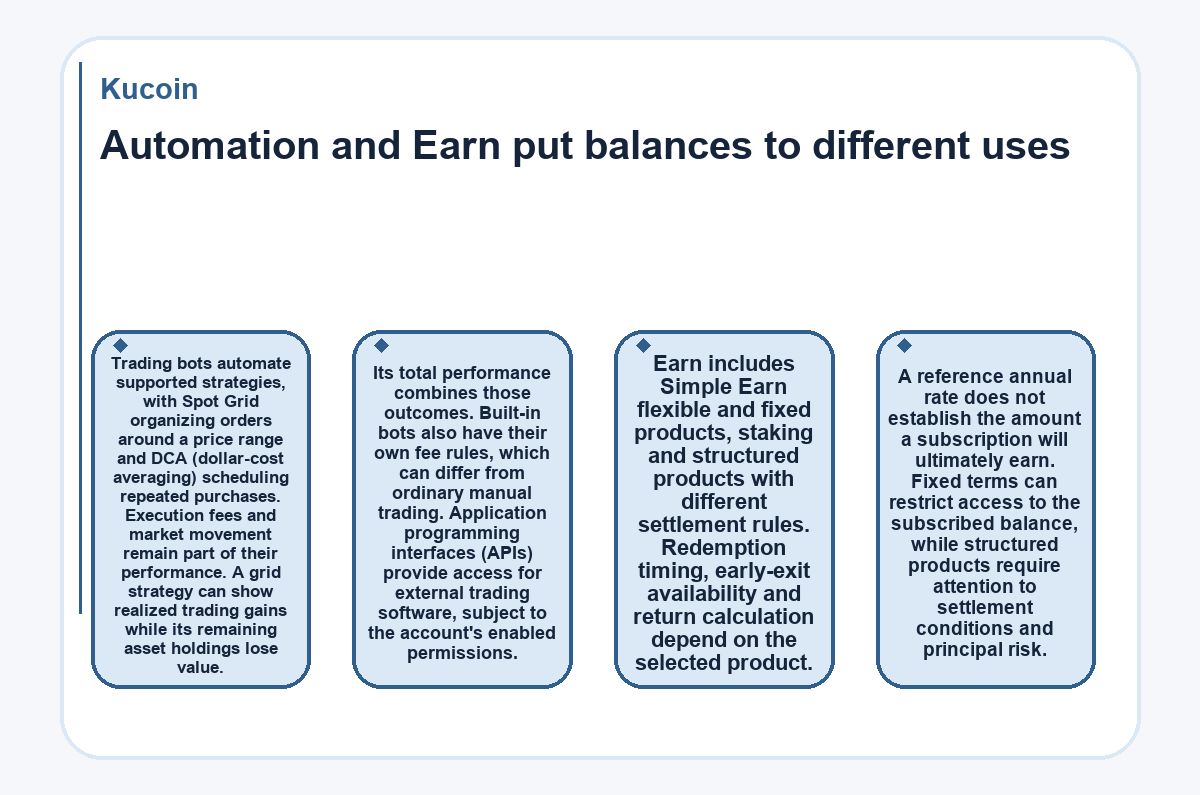
Earn includes Simple Earn flexible and fixed products, staking and structured products with different settlement rules. Redemption timing, early-exit availability and return calculation depend on the selected product. A reference annual rate does not establish the amount a subscription will ultimately earn. Fixed terms can restrict access to the subscribed balance, while structured products require attention to settlement conditions and principal risk.
Crypto transfers and fiat purchases have different requirements
A crypto deposit needs the correct asset and a transfer network supported by both the sending platform and the selected receiving address. Matching an asset's name alone is insufficient when it exists on several networks. The deposit screen identifies supported networks and any minimum amount. Some deposits also require a memo or tag to identify the recipient account.
On-chain deposits require blockchain confirmations for crediting and withdrawal eligibility. Requirements vary by asset and network, while congestion affects timing. Withdrawals have asset-specific minimums and fees shown for the selected network. A supported network must also match the destination's requirements; a cheaper incompatible route can send funds somewhere the recipient cannot credit.
Fiat funding, card purchases and third-party purchase services introduce payment-method pricing and availability conditions. P2P, meaning peer-to-peer trading, uses offers from counterparties with their own prices and payment instructions. Payment moves through the selected payment channel, while crypto release follows the P2P order. The payment-account identity must match the verified account information. These purchase routes can have different final costs from an order-book trade.
Who can use the exchange and its products?
New users must complete identity verification before using the global exchange's products and services, and regional restrictions can further limit eligibility. Know Your Customer (KYC) verification requires identity documentation and facial verification. The account gains verified status after the identity review succeeds.
The global service restricts access from specified locations, including the United States. Regional services can have different operators and product terms. A verified account does not override a product's location restrictions, particularly for derivatives and borrowing.
Exchange custody places assets within the operator's wallet infrastructure. Account access and withdrawal processing therefore remain part of the holding arrangement. Verification also involves sharing identity information, which creates a privacy consideration separate from public blockchain transaction records.
Two-factor authentication protects account access. The separate trading password is a six-digit code used for trading, withdrawals and API creation.
Kucoin: the short answers
Why can a stop order cancel after reaching its trigger price?
Insufficient funds can cancel a spot stop order when it triggers; price-protection limits can cancel the portion outside the permitted execution range. Kucoin reserves funds at the trigger, so balances committed elsewhere may leave too little available. A stop-limit order can also remain open if no matching order meets its limit. Reaching the trigger price starts execution checks and does not guarantee a fill.
Can an account created before mandatory verification still withdraw crypto?
Some accounts registered before August 31, 2023 retain crypto withdrawal access under the legacy unverified-account rules. Those rules restrict other activities, including deposits, new futures exposure and new borrowing. The withdrawal-page limit applies, and regional restrictions or account-specific controls can further affect access. This legacy treatment does not provide full services to a newly opened unverified account.
How does early deposit credit affect withdrawal availability?
Some supported deposits receive trading credit before they become eligible for withdrawal. Withdrawal requires the additional block confirmations specified for the asset and network. Block production and network conditions affect the wait; a balance appearing in the account does not remove that confirmation requirement.
Are KCS fee payments available for built-in trading bots?
KCS fee deduction does not apply to built-in trading bots. Spot bot strategies follow their bot-specific spot fee rules, while futures strategies have a separate schedule. Completed-trade records show the fee actually charged.
Will changing the trading password pause withdrawals?
Changing the trading password disables withdrawals for 24 hours and pauses P2P selling and Red Packet sending during that period. The new password takes effect immediately. Other specified security changes can also trigger withdrawal restrictions. A separate account risk restriction can remain active after the timed security pause ends.
Does a trading API key require withdrawal permission?
Trading API access does not require Withdrawal permission. Classic account keys use Spot, Margin or Futures permissions for their respective markets, while unified account trading has a separate Unified permission. General permission supports account and order queries without placing trades. A key with trading access can still create exposure and trading losses even when withdrawals are disabled.