Kucoin account types assign different uses to your exchange funds
Last updated
Kucoin separates classic exchange funds by use, with spot orders drawing on the Trading Account and withdrawals available from Funding or Trading balances. The Margin Account holds assets used for borrowing and repayment. Futures funds support contract positions, while Earn products carry their own subscription and redemption terms. Choosing where to keep funds means matching those functions to the next intended use. Total assets can include amounts reserved for orders, collateral or subscriptions. Those amounts need not be transferable. An optional Unified Trading Account changes the classic separation by sharing eligible collateral across spot and futures, subject to access and margin rules. Identity verification and regional eligibility also affect product access.
Unrealized gains on classic cross-margin futures positions can raise account equity without increasing the amount available for transfer.
Funding and Trading balances serve different functions
The Funding Account supports holding crypto, deposits, withdrawals and peer-to-peer trading, usually shortened to P2P. The Trading Account supplies funds for classic spot orders. These are functional divisions within an exchange account. Moving an asset between them changes its allocation without changing the asset itself.
A Funding balance can therefore remain visible in your portfolio while providing no spendable balance for a classic spot order.
In classic mode, spot buying requires the asset the selected market accepts for payment, while selling requires the asset being sold; in either case, the available Trading Account balance supplies the order. An overall positive portfolio value cannot substitute for the required currency. This distinction also applies when funds sit in another product account.
Funding is the usual location for P2P activity, but its withdrawal role is not exclusive. The withdrawal interface also supports Trading balances. Other account types have additional release or transfer conditions before their funds become available for an external withdrawal.
Margin balances include assets supporting debt
The Margin Account connects borrowed-asset trading with the funds needed to support positions and repay liabilities. Its asset balance can include borrowed funds, so the displayed holdings alone do not describe the account's net position. Debt and accrued interest remain relevant even when an asset appears in the account.
Outstanding debt also affects how much collateral can leave. Tiered collateral haircuts influence the amount the system recognizes for this calculation. A haircut assigns a reduced collateral value to an asset while leaving its token quantity unchanged. Cross and isolated margin have different collateral groupings, so transfer availability belongs to the cross-margin account or isolated trading-pair account.
Repayment funds belong in the Margin Account. Transferring the asset you owe into that account supplies the repayment balance but does not itself clear the loan.
Futures equity differs from transferable funds
The Futures Account holds funds supporting contract trading, with collateral eligibility governed by the selected contract and account configuration. Its equity can include unrealized profit or loss. Position margin, order margin and frozen funds affect how much remains available for other uses.
A profitable open position can increase equity without creating an equivalent amount available to move out.
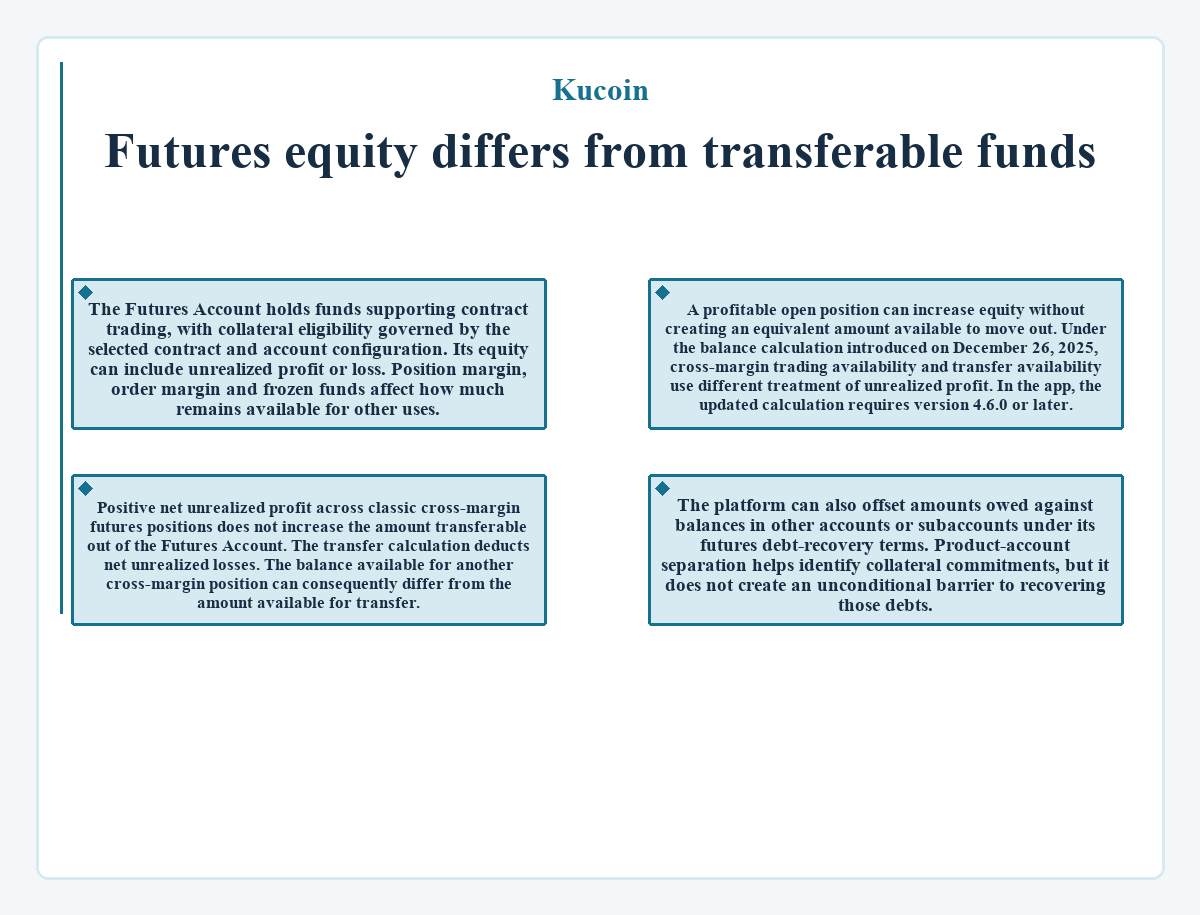
Under the balance calculation introduced on December 26, 2025, cross-margin trading availability and transfer availability use different treatment of unrealized profit. In the app, the updated calculation requires version 4.6.0 or later. Positive net unrealized profit across classic cross-margin futures positions does not increase the amount transferable out of the Futures Account. The transfer calculation deducts net unrealized losses. The balance available for another cross-margin position can consequently differ from the amount available for transfer.
The platform can also offset amounts owed against balances in other accounts or subaccounts under its futures debt-recovery terms. Product-account separation helps identify collateral commitments, but it does not create an unconditional barrier to recovering those debts.
Earn holdings follow the selected product's terms
Earn products have subscription and redemption rules determining when holdings become available for another purpose. Financial Account and Finance Account are also labels used for savings or staking holdings. Subscribed funds can require redemption even when their value remains visible in the portfolio. Savings permits flexible redemption, while a fixed-term subscription can keep funds committed until maturity. The selected product's redemption method, processing period and any applicable fee determine when the released balance becomes usable. Switching between account views does not change those product terms.
There are also documented exceptions to treating Earn as a separate location. KCUSD subscription principal and daily returns sit in the Funding Account, with access through both Funding and Earn views. Hold to Earn works differently again: after activation, eligible balances can earn while remaining in supported exchange accounts. It does not impose a separate subscription or redemption process.
Mining balances track output and electricity charges
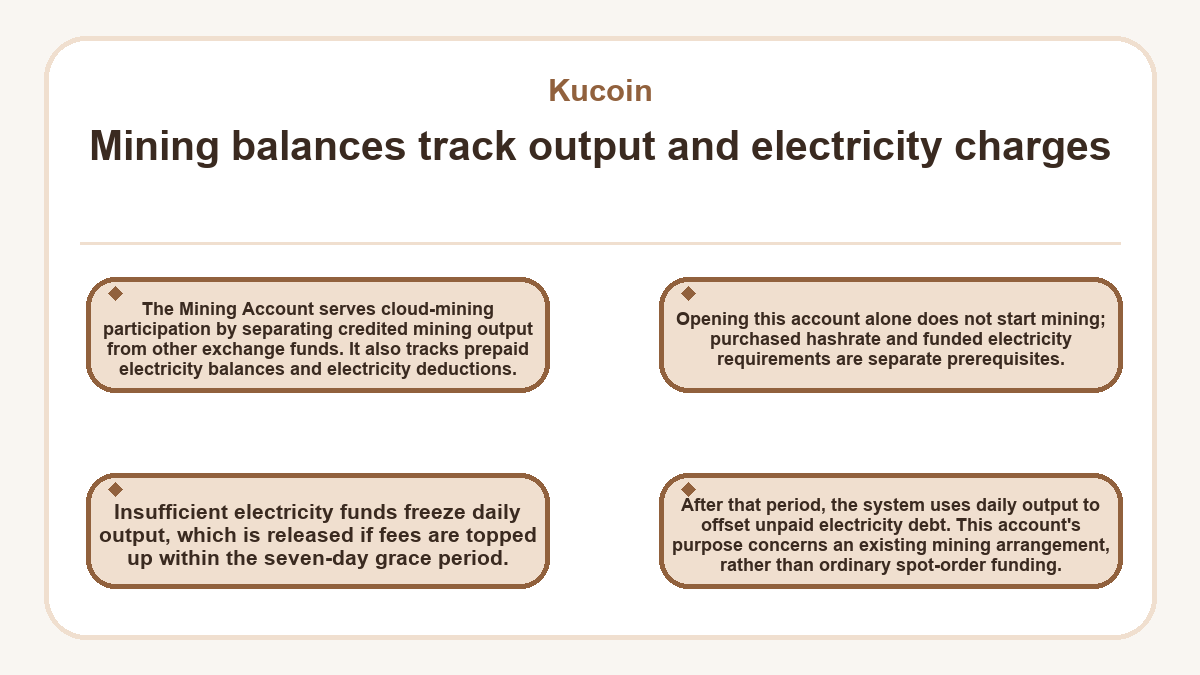
The Mining Account serves cloud-mining participation by separating credited mining output from other exchange funds. It also tracks prepaid electricity balances and electricity deductions. Opening this account alone does not start mining; purchased hashrate and funded electricity requirements are separate prerequisites. Insufficient electricity funds freeze daily output, which is released if fees are topped up within the seven-day grace period. After that period, the system uses daily output to offset unpaid electricity debt. This account's purpose concerns an existing mining arrangement, rather than ordinary spot-order funding.
Available balance describes what remains uncommitted
The available amount belongs to a particular asset and account, while a portfolio total can combine several balances. Classic spot account data distinguishes total balance, available funds and amounts on hold. Open orders can reserve funds. Moving money into Trading therefore does not ensure every unit remains available for another order or transfer.
Account location and balance status answer different questions. The location identifies the product using the funds; the status identifies restrictions on those funds. Margin collateral, futures commitments and subscribed Earn holdings each have their own release conditions. A different account destination cannot override those conditions merely because the portfolio still displays the assets.
This also affects Hold to Earn eligibility. Funds frozen for pending orders stop earning through that feature while committed. Uncommitted eligible balances can continue earning. Participation in an earning feature therefore does not make all parts of an account balance equally available or equally eligible for rewards.
Internal transfers change allocation within the exchange
A transfer between product accounts reallocates an existing asset balance within the exchange. It does not buy another asset or move the funds to a wallet you control. The source account's transferable amount constrains the request, and the destination must support the relevant asset and function. Depositing crypto from an external wallet is a separate operation, governed by the receiving asset, supported network and deposit requirements. An external deposit also depends on the minimum amount and confirmation requirements for the selected asset.
The term Internal Transfer can also describe a payment to another exchange user. That recipient-based transfer differs from moving your own funds between Funding and Trading. Recipient transfers can use an account identifier instead of a blockchain transaction, and they do not generate an on-chain transaction ID. Here the recipient identifies a different exchange user; in a product-account transfer, the destination identifies another balance within your own account.
Funding balances remain under exchange custody
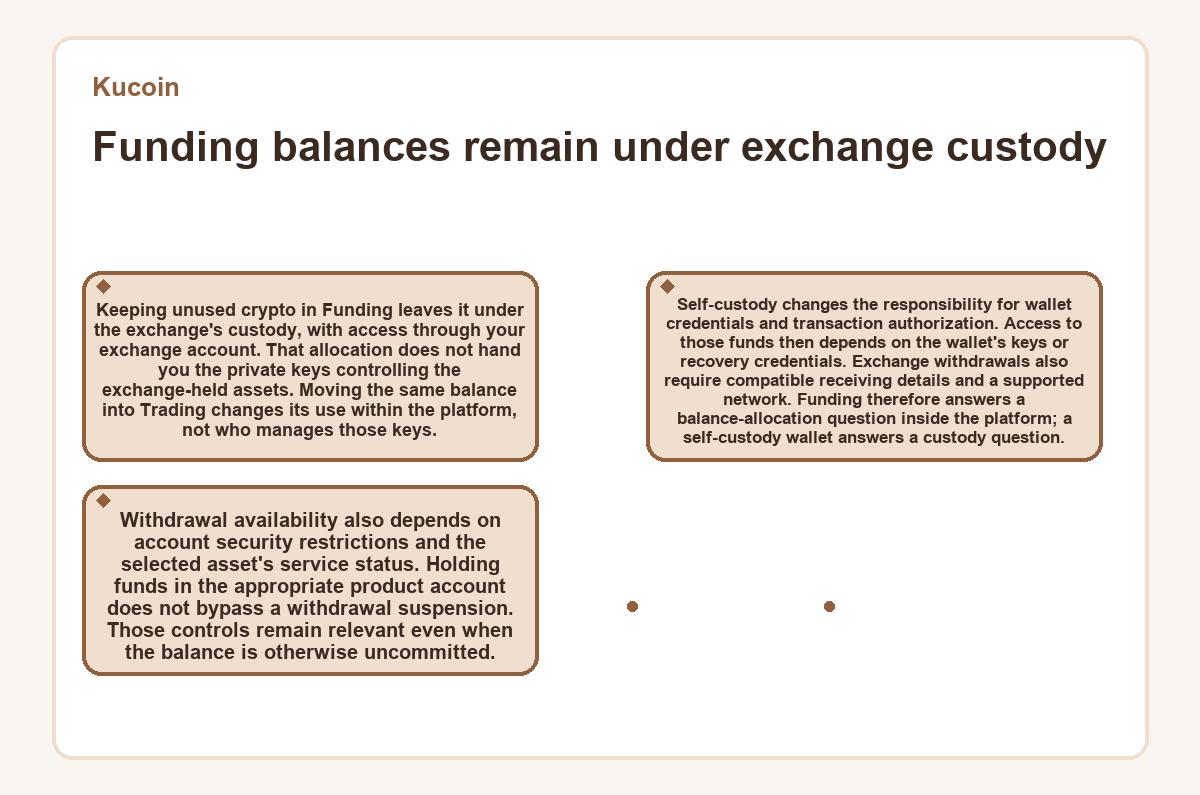
Keeping unused crypto in Funding leaves it under the exchange's custody, with access through your exchange account. That allocation does not hand you the private keys controlling the exchange-held assets. Moving the same balance into Trading changes its use within the platform, not who manages those keys.
Self-custody changes the responsibility for wallet credentials and transaction authorization. Access to those funds then depends on the wallet's keys or recovery credentials. Exchange withdrawals also require compatible receiving details and a supported network. Funding therefore answers a balance-allocation question inside the platform; a self-custody wallet answers a custody question.
Withdrawal availability also depends on account security restrictions and the selected asset's service status. Holding funds in the appropriate product account does not bypass a withdrawal suspension. Those controls remain relevant even when the balance is otherwise uncommitted.
Unified accounts change the classic collateral structure
The Unified Trading Account, or UTA, combines supported spot and futures activity within a shared account structure where access is enabled. UTA API V2 also supports cross-margin trading, but not isolated spot margin. Multi-currency margin allows eligible assets to contribute collateral after applicable discounts. Their full displayed market value need not equal their contribution to the margin balance.
Shared cross-margin collateral connects the positions using that pool. Profits can offset losses, while losses can reduce the support available to other positions. This can reduce repeated transfers between classic trading balances, but it also changes how exposure spreads within the shared pool. The August 18, 2026 upgrade made UTA available to users at VIP 1 and above, subject to eligibility and upgrade requirements.
UTA also supports isolated futures margin allocated to an individual position, using that contract's settlement currency as margin. Multi-currency collateral applies to the shared cross-margin pool. Adding isolated margin uses available cross-margin funds. Reducing leverage can also require an extra allocation if the position needs additional collateral. These futures margin modes differ from classic margin borrowing, which has its own loan balances, product permissions and collateral rules.
The intended use determines the account choice
A balance needed for a classic spot order and a balance needed for withdrawal have overlapping uses but different requirements. Classify the funds by the operation they must support, then by any existing commitment.
- For a classic spot order, the required asset must be available in Trading.
- For P2P activity, Funding supplies the relevant crypto balance.
- For a withdrawal, use an available Funding or Trading balance supported by the withdrawal interface.
- For classic margin repayment, the owed asset must be available in the relevant Margin Account.
- For futures collateral, use the selected contract's account and margin rules rather than the portfolio total.
- For subscribed Earn holdings, redemption terms determine release; Hold to Earn does not add a separate redemption requirement.
This classification changes when the account uses UTA: its supported spot and futures functions share the unified structure. Existing order commitments, collateral requirements and product restrictions continue to determine how much can be used or moved.
Frequently asked questions about Kucoin
Can a crypto deposit go directly into the Trading Account?
A crypto deposit can go directly into the Trading Account when that destination is available. This avoids a later transfer from Funding for classic spot trading. Identity verification remains a deposit prerequisite, and the chosen account does not replace the asset's network requirements. The receiving network must match the network used to send the deposit.
Why does Savings Auto-Subscribe reduce my Trading Account balance?
Savings Auto-Subscribe can automatically move the selected currency from Trading or Funding into the chosen Savings product. Enabling it authorizes recurring Savings subscriptions. Subscribed funds then follow the Savings product's rules. The reduction in the source account can therefore reflect a subscription rather than a trade or external withdrawal.
Which accounts can supply KCS for trading fee payments?
Eligible classic spot and margin trades can use KCS held in Funding or Trading for fee payments, with a separate option for KCS Staking holdings. The fee-payment setting must be enabled, and using staked amounts requires its own setting. Holding KCS somewhere in the portfolio does not establish eligibility for every trade. Available balance, trade eligibility and the applicable fee conditions still govern payment.
Are withdrawals from a subaccount handled through the master account?
Standard subaccounts cannot perform their own withdrawals, so their funds must first be transferred to the master account for withdrawal. The master can transfer funds from standard subaccounts and manage transfers between them. Keeping funds in a standard subaccount's Funding Account does not change its withdrawal restriction. Cactus-linked custodial subaccounts use Cactus Custody's delegation and non-delegation functions instead; transfers to or from the master account are unsupported.
Does the Unified Trading Account require an API connection?
UTA can be used without an API connection where the account has access to the feature. An API is needed for programmatic trading, not ordinary use through the supported interface. A subaccount using API trading requires its own appropriately configured key; the master account's key cannot be used as the subaccount's trading key.
What prevents an account from switching to unified mode?
Open futures positions, pending spot or futures orders, outstanding liabilities and negative balances prevent the documented UTA upgrade. Access eligibility is a separate requirement. Trading and fund transfers become temporarily unavailable during the upgrade itself. Clearing an order or liability therefore addresses an upgrade prerequisite, but it does not establish that the account has access to UTA.
Will activating UTA automatically move my existing classic balances?
Activating UTA leaves existing assets in their classic accounts, so the unified trading balance needs a separate transfer. Funds remaining in classic product accounts retain their existing commitments and release conditions.
How does a mining hashrate estimate differ from the account balance?
A hashrate estimate values projected future mining output and does not represent a withdrawable balance. Its value depends on mining difficulty, hashrate, the mining period and asset prices. Credited mining output and prepaid electricity funds are actual account entries with their own restrictions. Forecast value should therefore remain separate from funds currently available to use or transfer.